Resident: Adam J. Bottrill
Date: 26FEB10
Region: Providence
Article title: Herpetic gingivostomatitis and teething difficulty in infants
Author(s): King, David et. al.
Journal: Pediatric Dentistry
Page #s: pp. 82-85
Year: March/April 1992
Major topic: Primary herpetic gingivostomatitis (PHG)
Minor topic(s): Teething
Type of Article: Retrospective investigation
Main Purpose: The aim of this study was to determine whether PHG may be responsible for signs and symptoms commonly attributed to teething in infants.
Overview of method of research: Patient study and comparison. 20 infants with parental diagnosis of “teething difficulty.” 20 infants serving as controls.
Key points in the article discussion:
I. Oral swab obtained from the infants and processed to determine presence of HSV.
A. Temp and oral status recorded.
B. 9 subjects positive for HSV
C. 7 of 9 had temperature
D. All 9 had varying degrees of visible oral infection
E. Of the remaining 11, 5 had temperatures and none had visible infeciton (otitis media, vericella).
F. The control group was negative for HSV, temp AND visible infection.
II. Results: HSV should be included in differential Dx of patients with CC of “teething difficulty”
A. Finding of HSV “highly significant” in the DDX of teething difficulty.
B. 80-90% of adults have serum AB’s to HSV. Many don’t remember having it. This could be due to undiagnosed infant PHG.
C. Infants with teething difficulty should be more closely analyzed for PHG.
Assessment of article: Short and Sweet. Negative on the Shenanigans.
Showing posts with label 2/26/2010. Show all posts
Showing posts with label 2/26/2010. Show all posts
Thursday, February 25, 2010

Hepatitis B Virus Infection 2/26/10
Department of Pediatric Dentistry
Resident’s Name:Murphy Program: Lutheran Medical Center - Providence
Article title: Hepatitis B Virus Infection
Author(s): Cottone DMD, James. Raghunath Puttaiah, BDS, MPH
Journal: Dental Clinics of North America
Year. Volume (number). Page #’s: 1996. 40(2). 293-307
Major topic: HBV
Minor topic(s): Implications in dentistry
Main Purpose: Review HBV and its occurrence/incidence in the dental setting
Overview of method of research: Review
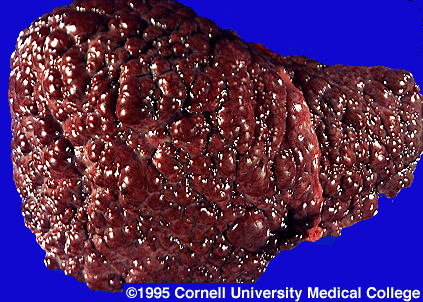
Findings: Hepatitis, or inflammation of the liver, is can be caused by many things, including viruses, certain diseases, and drug reactions. HBV is one of these viruses. When considering infection control protocols in the dental setting, HBV is the target disease. First described in 1965, HBV is a major cause of acute and chronic liver infection, cirrhosis, and primary hepatocellular carcinoma worldwide. The frequency of HBV varies workdwide, with 90% of the 300 million carriers being in underdeveloped countries (there are over 1,000,000 carriers in the US alone). Clinical signs and symptoms of acute HBV infection include some combination of anorexia, malaise, nausea, vomiting, abdominal pain, jaundice, skin rashes, athralgias, and arthritis. The incubation period of HBV is long…45-160 days. Sequelae to HBV infection could be asymptomatic, symptomatic carrier state, cirrhosis, acute hepatitis infection, primary liver cancer, or death.
HBV can be transmitted both percutaneously and non-percutaneously. Percutaneous transmission is from some kind of stick with a sharp instrument/needle. Non perc. Includes transfer of bodily secretions such as saliva, blood, and cervicular fluid. Transmission of HBV during dental dental treatment occurs primarily in the horizontal mode among staff and patients, mostly from patient to provider and less likely from provider to patient. The risk of HBV is more a factor of exposure to blood than to general patient contact. Intraorally the greatest concentration of HBV is at the gingival sulcus.
Thanks to awareness and immunization, the HBV carrier rate for dentists is only .4%. Dentists who are nonimmune are three times more likely to aquire HBV, and nonimmune specialists are at six times the risk. Oral surgeons have the highest carrier rate at 38.5%. Sorry Dr. Sam!! When compared with HIV, we are 57 times more likely to become infected with HBV.
Vaccines for HBV include a plasma derived vaccine and a recombinant DNA vaccine.
Key points/Summary: As always, proper infection control and universal precautions should always be used for every patient. It’s important that you educate your staff about HBV and other job hazards associated with dentistry. Making sure you and your staff are properly vaccinated, and are up to date with your vaccinations is paramount.
Assessment of Article: Good article….nice review of HBV and it’s implications for us. No shenanigans yo.


Resident’s Name:Murphy Program: Lutheran Medical Center - Providence
Article title: Hepatitis B Virus Infection
Author(s): Cottone DMD, James. Raghunath Puttaiah, BDS, MPH
Journal: Dental Clinics of North America
Year. Volume (number). Page #’s: 1996. 40(2). 293-307
Major topic: HBV
Minor topic(s): Implications in dentistry
Main Purpose: Review HBV and its occurrence/incidence in the dental setting
Overview of method of research: Review
Findings: Hepatitis, or inflammation of the liver, is can be caused by many things, including viruses, certain diseases, and drug reactions. HBV is one of these viruses. When considering infection control protocols in the dental setting, HBV is the target disease. First described in 1965, HBV is a major cause of acute and chronic liver infection, cirrhosis, and primary hepatocellular carcinoma worldwide. The frequency of HBV varies workdwide, with 90% of the 300 million carriers being in underdeveloped countries (there are over 1,000,000 carriers in the US alone). Clinical signs and symptoms of acute HBV infection include some combination of anorexia, malaise, nausea, vomiting, abdominal pain, jaundice, skin rashes, athralgias, and arthritis. The incubation period of HBV is long…45-160 days. Sequelae to HBV infection could be asymptomatic, symptomatic carrier state, cirrhosis, acute hepatitis infection, primary liver cancer, or death.
HBV can be transmitted both percutaneously and non-percutaneously. Percutaneous transmission is from some kind of stick with a sharp instrument/needle. Non perc. Includes transfer of bodily secretions such as saliva, blood, and cervicular fluid. Transmission of HBV during dental dental treatment occurs primarily in the horizontal mode among staff and patients, mostly from patient to provider and less likely from provider to patient. The risk of HBV is more a factor of exposure to blood than to general patient contact. Intraorally the greatest concentration of HBV is at the gingival sulcus.
Thanks to awareness and immunization, the HBV carrier rate for dentists is only .4%. Dentists who are nonimmune are three times more likely to aquire HBV, and nonimmune specialists are at six times the risk. Oral surgeons have the highest carrier rate at 38.5%. Sorry Dr. Sam!! When compared with HIV, we are 57 times more likely to become infected with HBV.
Vaccines for HBV include a plasma derived vaccine and a recombinant DNA vaccine.
Key points/Summary: As always, proper infection control and universal precautions should always be used for every patient. It’s important that you educate your staff about HBV and other job hazards associated with dentistry. Making sure you and your staff are properly vaccinated, and are up to date with your vaccinations is paramount.
Assessment of Article: Good article….nice review of HBV and it’s implications for us. No shenanigans yo.

Sunday, February 21, 2010
Hepatitis C Virus Infection; A review and implications for the dentist
Resident: Roberts
Date: 2/26/10
Article title: Hepatitis C Virus Infection; A review and implications for the dentist
Author: Steven D. Vincent
Journal: Eastman Dental Institute for Oral Health Care Sciences, University of London
Volume: 86 Pages 8-22
Year: 1997
Discussion: Hepatitis C Virus is an RNA virus that is present throughout the world. The virus has many variations and frequently mutates due to poor replication, thus a vaccine or postoperative prophylaxis is far from reaching the marketplace. The virus is mainly transmitted through blood contact, though a large percentage of carriers have an unknown origin. The virus causes chronic hepatitis resulting in cirrhosis and hepatocellular carcinoma in a large majority of its host( after 20 – 30 years of being infected). Interferon alpha is currently the drug of choice but is only effective in about 25% of patients. The most common oral manifestation of the drug is lichen planus or sialadenitis. There have been few reports of noscomial transmission of HCV; however, the prevalence of HCV infection among dental HCW’s is similar to that in the general population.
Assessment: I was left high and dry after the article suggested that is was geared towards dentist. There wasn't a whole lot of information you could really hang your hat on for clinical relevance.
Date: 2/26/10
Article title: Hepatitis C Virus Infection; A review and implications for the dentist
Author: Steven D. Vincent
Journal: Eastman Dental Institute for Oral Health Care Sciences, University of London
Volume: 86 Pages 8-22
Year: 1997
Discussion: Hepatitis C Virus is an RNA virus that is present throughout the world. The virus has many variations and frequently mutates due to poor replication, thus a vaccine or postoperative prophylaxis is far from reaching the marketplace. The virus is mainly transmitted through blood contact, though a large percentage of carriers have an unknown origin. The virus causes chronic hepatitis resulting in cirrhosis and hepatocellular carcinoma in a large majority of its host( after 20 – 30 years of being infected). Interferon alpha is currently the drug of choice but is only effective in about 25% of patients. The most common oral manifestation of the drug is lichen planus or sialadenitis. There have been few reports of noscomial transmission of HCV; however, the prevalence of HCV infection among dental HCW’s is similar to that in the general population.
Assessment: I was left high and dry after the article suggested that is was geared towards dentist. There wasn't a whole lot of information you could really hang your hat on for clinical relevance.
Subscribe to:
Posts (Atom)